
Showing posts with label pay commission. Show all posts
Showing posts with label pay commission. Show all posts
7th Pay Commission update: Rajasthan govt implements recommendations
Thursday, October 19, 2017
0
comments
Giving a Diwali bonanza to over 12 lakh state employees, Rajasthan Chief Minister Vasundhara Raje on Tuesday announced to implement the recommendations of the 7th Pay Commission. The state government employees will get the revised salary from the month of October. Rajasthan Chief Minister Raje in a statement said that she had promised to implement the pay commission's recommendation in the 2017-18 budget and was happy to implement it from October. She further said that a panel had been authorised to examine cases of salary discrepancies, allowances and arrears. "The state government considers its employees the backbone of governance and was sensitive towards their welfare," the statement said.

Rajasthan is the latest entrant in the league of states that have announced to implement the recommendations made by 7th Pay Commission. States such as Maharashtra, Madhya Pradesh, Uttarakhand, Uttar Pradesh, Jammu and Kashmir, Haryana, Tripura, Tamil Nadu and Goa have already announced their decisions.
Earlier this month, the Tamil Nadu state Cabinet consented to implement the recommendations of Pay Commission. After the implementation of the decision, salaries for state government employees and teachers will reportedly increase by 20 per cent. This move will benefit more than 10 lakh government employees and pensioners in the state. However, the revised salary will be effective from October 1, 2017, which would mean losing arrears for 21 months which the state government employees were expecting. While accepting the recommendations by the 7th Pay Commission, the Tamil Nadu Cabinet under Chief Minister Edappadi K Palaniswami did not agree to enact the changes from a retrospective date. The government employees in Tamil Nadu were expecting that the pay panel recommendations will be put into effect from January 1, 2016.
Tamil Nadu state government employees' expectations were somewhat justifiable as many state governments and even the central government had approved the pay commission's recommendation from the back date. Recently, the Union cabinet cleared revised pay scales for about 7.58 lakh teachers and academic staff of higher educational institutions following the implementation of the 7th Pay Commission. In a press statement, the central government said that the approved pay scales would be applicable from January 2016.
Pay bonanza for Central government employees. Exclusive news from CNN IBN
Sunday, October 4, 2015
0
comments
Pay bonanza for Central government employees. Exclusive news from CNN IBN.
Watch the video below.
Watch the video below.
NEW DELHI: To counter criticism over Members of Parliament deciding their own salaries, the government has proposed to set up an independent three-member emoluments commission, which would recommend salaries and other allowances for the lawmakers.
The proposal will come up for discussion at the two day All India Whips’ Conference to be held at Visakhapatnam, Andhra Pradesh on September 29.
The new proposal to set up the panel comes after the government had to shelve the recommendations of a parliamentary committee headed by BJP MP Yogi Adityanath recommended a hundred per cent hike in MP’s salary from current Rs 50,000 top Rs One lakh, and massive hikes in other allowances. The outrage over these recommendations appears to have prompted the government to propose an alternative to decide on pay hike for the parliamentarians

According to the new proposal, the ministry of parliamentary affairs has suggested three general principles. “Salary should not be so low as to defer suitable candidates or so high as to make pay the primary attraction for the job; salary should reflect level of responsibility; and those with outside interests should not be deterred from entering Parliament, those who chose to make Parliament a full-time career should be adequately rewarded to reflect their responsibilities,” said the guiding principles for the proposed commission.
Presently, as per Article 106 of the Constitution, salaries of MPs are determined by 1954 act. The last revision in salary of MPs was made in 2010.
Apart from the Rs 50,000 per month basic salary, an MP gets Rs 2,000 per day as daily allowance when the MP signs the register while attending Parliament sessions or House committee meetings. The MP is also entitled to Rs 45,000 constituency allowance every month -- Rs 15,000 for stationery and Rs 30,000 to employ secretarial assistance staff. MPs are also entitled for a government accommodation, air travel and train travel facilities, besides three landline and two mobile phones. They also get a loan of Rs 4 lakh to buy a vehicle.
The ministry of parliamentary affairs in the agenda notes for the proposed commission argued that comparative analysis of MPs salary in 37 developing and developed countries, the basic pay was in the range of Rs.7,952 in Tunisia to a high of Rs.6.16 lakhs in Israel. MPs of only in six countries like Tunisia, Venezuela, Sri Lanka, Nepal, Haiti and Panama are drawing salary less than that of Indian MPs.
Talking about the need to have an independent commission, the ministry in its agenda notes said, “The setting up of an independent Emoluments Commission will not only put to rest the public outcry and media criticism over MPs themselves deciding their salaries, it will also provide opportunity to consider their huge responsibilities and important role in representative democracy.”
“It would ensure that recommendations on Parliamentary salary are reached in a fair, transparent and equitable way,” the ministry added.
The issue of salary hike will be discussed in the Visakhapatnam conference, where other issues like implementation of MPLADS scheme will also be discussed.
Many news papers including Danik Bhaskar, Times of India, NDTV CNN IBN, Hindu etc had reported that the 7th CPC will be submitting its report on 30th September 2015 itself.
The 7th CPC chairman had informed in a PTI interview Justice Ashok Kumar Mathurji had stated that “The Commission will submit its report by the end of September,”
The Hon’able Finance Minister had also informed the 7th CPC report will be submitted shortly.

The 7th Pay Commission has asked for a two month extension from the government. That the Commission is hoping that the government would take a call on One Rank One Pension, so they could modulate their own formulation in terms of pay revision. Now the one rank one pension issue has been resolved, but the formal orders are not issued, it will be issued only next month. After the issue of the ORBP orders then 7th Pay Commission will submit its report.
Now four month extension of term of 7th Central Pay Commission is made the Union Cabinet chaired by the Hon’able Prime Minister, gave its approval for the extension of the term of the 7th Central Pay Commission by four months up to 31.12.2015. The Government had issued notification on 8th September “The Commission will make its recommendations by 31st December, 2015. It may consider, if necessary, sending reports on any of the matters as and when the recommendations are finalized.”
Now the delay in submission of report and its implementation will be there and actual benefit of 7th CPC will occur only from April 2016. As Government will constitute its own committee to study the implementation of the 7th CPC report and issuing orders. It will benefit the Government as allowances effective date may be from April 2016 instead of January 2016.
Now the delay in submission of report and its implementation will be there and actual benefit of 7th CPC will occur only from April 2016. As Government will constitute its own committee to study the implementation of the 7th CPC report and issuing orders. It will benefit the Government as allowances effective date may be from April 2016 instead of January 2016.
When will the 7th CPC will submit its report? There are three possibilities now on submission date.
a) If the 7th CPC feels that the assigned work has been completed it can submit its report any time, it’s only up to the 7th CPC and the Central Government. If the 7th CPC report is completed and ready for release as per paper reports then in these case the 7th CPC can directly submit its report to the Finance Ministry on 30th September without publishing the report in public due to Bihar elections. If election commission gives clearance then the 7th CPC report will be made public.
b) There is one more possibility is that the 7th CPC report will be submitted after Bihar elections ie after November 6th.
c) Last option is that report will be submitted only in December 2015 only.
We sincerely hope the 7th CPC report will be submitted at the earliest and the Central Government will implement the report at the earliest, so that the aspiration of the Central Government employees are taken care by the Central Government.
Comradely yours
(P.S.Prasad)
General Secretary
COC Karnataka
Source : http://karnatakacoc.blogspot.in/
7th Pay Commission to submit its report soon, economical condition will decide increase in salary
Friday, September 25, 2015
1 comments
7th Pay Commission to submit its report soon, economical condition will decide increase in salary

सातवां वेतन आयोग जल्द सौंपेगा अपनी रिपोर्ट, लाखों कर्मचारियों को होगा फायदा
Thursday, September 24, 2015
0
comments
source: znews
नई दिल्ली: सातवां वेतन आयोग जल्द ही वित्त मंत्रालय को अपनी रिपोर्ट सौंपने वाला है। मीडिया रिपोर्ट्स के मुताबिक, आयोग की रिपोर्ट लगभग तैयार है और जल्द ही सरकार को सौंपी जा सकती है। सातवें वेतन आयोग की सिफारिशे लागू होने पर 48 लाख केंद्रीय कर्मचारियों और 55 लाख पेंशनभोगियों को लाभ मिलेगा। गौरतलब है कि इससे पहले पिछले महीने ही सरकार ने आयोग का कार्यकाल चार महीने के लिए बढ़ा दिया था और आयोग को 31 दिसंबर तक सिफारिशें देने को कहा था।

सूत्रों के मुताबिक, आयोग की सिफारिशों का राज्य सरकार के कर्मचारियों के वेतन पर भी असर पड सकता है। आयोग को सिफारिशें देने के लिए 18 महीने का वक्त दिया गया था। तय वक्त के समाप्त होने से एक दिन पहले ही आयोग का कार्यकाल बढ़ा दिया गया था। जस्टिस ए.के. माथुर की अध्यक्षता वाले आयोग की नियुक्ति फरवरी 2014 में की गयी थी और उसकी सिफारिशें एक जनवरी 2016 से प्रभाव में आएंगी।

Earlier in August, the government had extended Commission's term by another four months till December 31 to give recommendations.
"The Commission is ready with recommendations and the report will be submitted soon," according to sources.
The Commission, whose recommendations may also have a bearing on the salaries of the state government staff, was given more time by the Union Cabinet just a day before its original 18-month term was coming to an end.
Headed by Justice AK Mathur, the Commission was appointed in February 2014 and its recommendations are scheduled to take effect from January 1, 2016.
The government constitutes the Pay Commission almost every 10 years to revise the pay scale of its employees and often states also implement the panel's recommendations after some modifications.
As part of the exercise, the Commission holds discussions with various stakeholders, including organisations, federations, groups representing civil employees as well as defence services.
Meena Agarwal is the secretary of the Commission. Other members are Vivek Rae, a retired IAS officer of 1978 batch and Rathin Roy, an economist.
The Sixth Pay Commission was implemented with effect from January 1, 2006, the fifth from January 1, 1996 and the fourth from January 1, 1986.
source: timesofindia
7वें वेतन आयोग ने सिफारिशें केंद्र को सौंपी- प्रमुख हिंदी समाचार पत्र दैनिक भास्कर ने दावा किया है कि वेतन आयोग की रिपोर्ट की प्रति उसके पास उपलब्ध है। समाचार पत्र ने दावा किया है कि 31 दिसंबर तक इन पर आखिरी फैसला होगा। केंद्र सरकार ने हाल ही में 7वें वेतन आयोग के समय में 4 महीने विस्तार दिया है।
7th पे कमीशन में तीन गुना तक बढ़ सकती है केंद्रीय कर्मचारियों की सैलरी: दैनिक भास्कर
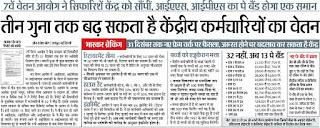
आयोग के अध्यक्ष अशोक कुमार माथुर, सचिव मीना अग्रवाल व सदस्य डॉ. राथिन राय व विवेक राक ने ये रिपोर्ट तैयार की है। रिपोर्ट की सिफारिशों के अनुसार इस समय कर्मचारियों के 32 पे-बैंड हैं। इसके अलावा भारत सरकार के सचिव तथा कैबिनेट सचिव के अलग से पे-बैंड हैं। इन्हें घटाकर 13 किए जाने का प्रस्ताव है। पे-बैंड कम हो जाने से आईएएस, आईपीएस और आईआरएस के पे-बैंड एक समान हो जाएंगे। एक रूपता आने से आईपीएस व आईआरएस की यह शिकायत दूर हो जाएगी कि उन्हें आईएएस से कम वेतन मिलता है।


source: bhaskar.com
7th पे कमीशन में तीन गुना तक बढ़ सकती है केंद्रीय कर्मचारियों की सैलरी: दैनिक भास्कर
रायपुर/नई दिल्ली. Sep 23, 2015 7th पे कमीशन ने केंद्र सरकार को सिफारिशें सौंप दी हैं। 31 दिसंबर तक इन पर आखिरी फैसला होगा। जरूरी हुआ तो कुछ बदलाव भी संभव है। इसके बाद इसे वित्त विभाग को भेजा जाएगा। नए वेतन आयोग में आईएएस, आईपीएस व आईआरएस अफसरों के वेतन में एकरूपता का प्रस्ताव है। साथ ही अफसरों-कर्मचारियों के वेतन को तीन गुना तक बढ़ाने का भी प्रस्ताव है।

आयोग के अध्यक्ष अशोक कुमार माथुर, सचिव मीना अग्रवाल व सदस्य डॉ. राथिन राय व विवेक राक ने ये रिपोर्ट तैयार की है। रिपोर्ट की सिफारिशों के अनुसार इस समय कर्मचारियों के 32 पे-बैंड हैं। इसके अलावा भारत सरकार के सचिव तथा कैबिनेट सचिव के अलग से पे-बैंड हैं। इन्हें घटाकर 13 किए जाने का प्रस्ताव है। पे-बैंड कम हो जाने से आईएएस, आईपीएस और आईआरएस के पे-बैंड एक समान हो जाएंगे। एक रूपता आने से आईपीएस व आईआरएस की यह शिकायत दूर हो जाएगी कि उन्हें आईएएस से कम वेतन मिलता है।
बच्चों को एजुकेशन अलाउंस

> केंद्रीय कर्मचारियों के कक्षा पहली से दसवीं तक के बच्चों को 40 रुपए और 11वीं व 12वीं के बच्चों को हर महीने 50 रुपए शिक्षा भत्ता देने का प्रस्ताव।
> बच्चा विकलांग या मानसिक रूप से अक्षम है तो 100 रुपए शिक्षा भत्ता मिलेगा। बच्चा माता-पिता के साथ न रहकर दूसरी जगह रह रहा है तो भी उसे सौ रुपए देने का प्रस्ताव।
> बच्चा हाॅस्टल में है तो अलग से हर माह 300 रुपए मिलेंगे। शर्त यह है कि जो बच्चे 1987 के पहले पैदा हुए हैं उनमें तीन संतान और 1987 के बाद संतान हुई है तो दो बच्चों को ही यह सुविधा मिलेगी।
नए पे-बैंड में क्या है खास
> ग्रेड बी और सी के लिए एक-एक रनिंग पे-बैंड।
> ग्रुप ए के पदों के लिए दो रनिंग पे-बैंड होंगे।
> केंद्रीय सचिव व कैबिनेट सचिव के लिए अलग स्केल देने का प्रस्ताव।
> पे-बैंड में एक के लिए कम से कम पे स्केल 21, 200 रु. सचिव के लिए कम से कम 2 लाख रु तक करने की सिफारिश।
नोट: एस 31 से 36 जो 6ठवें वेतन आयोग में था जिसमें केंद्र के ज्वाइंट सेक्रेटरी, एडिशनल सेक्रेटरी व केबिनेट सेक्रेटरी शामिल थे विलोप कर दिया गया।
source: bhaskar.com
Seventh Pay Commission Likely To Propose Minimum Pay Rs 20,000
Tuesday, September 22, 2015
1 comments
New Delhi: The Seventh Pay Commission is likely to propose minimum basic salary Rs 20,000 of central government employees.

Highly-placed sources in the pay panel said on Monday, “the average increase in basic pay for all government employees will be in the region of 30-40%.”
Currently, the minimum basic salary of central government employees is Rs 7000 with Grade pay excluding dearness and other allowances. After the sixth pay commission recommendations will come into force, the minimum basic salary will be 20,000 excluding dearness and other allowances.

A competitive minimum pay is important because it determines the the socialism view of the government and the higher number of central government employees in the minimum pay slabs. Apart from giving good salary to its lower grade employees, the central government also has to consider the disparity ratio between its highest and lowest paid employees.
“A joint secretary gets now Rs 128,000 as monthly salary with dearness allowance. I do not expect it to go up to more than Rs 160,000,” a joint secretary-level official of the Central Government said.
The first, second, third, fourth, fifth pay and sixth pay commission recommended the minimum basic salary Rs 35, Rs 80, Rs 260, Rs 950, Rs 3050 and Rs 7730 respectively.
The Commission has already completed discussions with various stakeholders, including organisations, federations, groups representing civil employees as well as Defence services and is in the process of finalising its recommendations.
It’s now in the process of finalising its recommendations.
The Seventh Pay Commission is also likely to keep the retirement age of central government employees unchanged at 60 years, although most of the central employees bodies sought to increase the retirement age to 62 years in their memorandum in the pay panel.
“We are not going to either recommend lowering or raising the retirement age. If we lower the age limit, the pension burden will bust the government’s medium-term fiscal targets.” highly-placed sources in the pay panel said.
SOURCE: tkbsen.in
Seventh Pay Commission’s Report To Be Implemented Ahead Of States Elections In May
Monday, September 21, 2015
0
comments
New Delhi: Ahead of the states’ assembly elections in May’ 2016, the Central government may implement the recommendations of the Seventh Pay Commission after receiving the report of the pay panel within this year, which will benefit 50 lakh central government employees and 56 lakh pensioners including dependents.

Prime Minister Narendra Modi
“The central government will decide execution time of the pay commission’s proposals after the pay panel submits its report, which will be possible pre-election “special packages” for West Bengal, Assam, Kerala and Tamil Nadu, which are all due for polls by May 2016,” an official of the Finance Ministry said, speaking on condition of anonymity.
Just like one rank one pension (OROP) was announced by Modi government on 5th of this month ahead of Bihar Assembly election despite huge financial burden to get majority seats of his party in Bihar Assembly.
OROP announcement not only is pre-election BJP’s special package but also Union cabinet approved six percent increase in DA for central government employees on Wednesday, making the total to 119 percent, on a day the Election Commission announced poll dates for Bihar is a move that would benefit the BJP in Bihar Assembly Election.
Accordingly, JD (U) leader K C Tyagi said, “The Modi government gave a ‘political bribe’ to voters. I welcome the DA hike for central government employees, but, I feel the, timing of the announcement is not correct.”
BJP needs to win most state elections in the next four years to gain control of the Rajya Sabha, where seats are distributed based on the strength of parties in state assemblies.
A defeat for Prime Minister Narendra Modi would harm his chances of consolidating power in parliament, where his reform agenda is being blocked because his party is in the minority in the Rajya Sabha.
So, Modi led BJP government is ready to give any sop to win states assemblies electons.
Finance Minister Arun Jaitley said on August 30, that report of Seventh Pay Commission for central government employees was coming shortly.
However, Chairman of the Seventh Pay Commission, Justice Ashok Kumar Mathur told PTI on August 25, “The Commission will submit its report by the end of September.”
Now, it is expected that recommendations of Seventh Pay Commission, will be implemented before the announcement of West Bengal, Assam, Kerala and Tamil Nadu states assemblies’ election in May 2016.
The Seventh Pay Commission, which was set up by the UPA government, was required to submit its report by August-end.The government constitutes the Pay Commission almost every 10 years to revise the pay scale of its employees and often these are adopted by states after some modifications.
The Commission has already completed discussions with various stakeholders, including organisations, federations, groups representing civil employees as well as Defence services and is in the process of finalising its recommendations.
The recommendations of the Seventh Pay Commission are scheduled to come into effect from January 1, 2016.
The Sixth Pay Commission was implemented with effect from January 1, 2006, the fifth from January 1, 1996 and the fourth from January 1, 1986.
source: tkbsen.in
New Delhi: The Seventh Pay Commission report is awaited, the new pay scales will be applicable to Central government employees with effect from January 2016.

50 lakh central government employees and 56 lakh pensioners including dependents hope to get this gift from April next year. The revised pay scales are likely to be implemented retrospectively starting 1 January 2016.
Many commentators say that the average increase in basic fair pay for all government employees will be in the region of 40-45%.
Many commentators say that the average increase in basic fair pay for all government employees will be in the region of 40-45%.
This is a very rough average because for senior level officers, like the Cabinet Secretary or officials at the secretary level, the payback could increase by more than 50%.

As the Pay Commission numbers come through there could be a 30-40 per cent increase for each central government employee.
An increase of salary and allowances would boost middle class central government employees to spend more time with their families for marketing.
The economy would get a major boost from a pickup in consumption, resulting from an increase in salaries but the flip side to the hike will be a spike in inflation.
The reports of Seventh Pay Commission will be implicated from April next year as Finance Minister Arun Jaitley said in the Parliament on February 27, “The Seventh Pay Commission impact may have to be absorbed in 2016-17.”
Finance Minister Arun Jaitley said above statement in his pre-budget speech. His statement indicates that the government may implement Seventh Pay Commission report from April 2016.
The strongest criticism of Pay Commission awards is that they play havoc with government finances. The pervious pay commissions’ rollout has been negative for fiscal balances.
The recommendations of the second pay commission were accompanied with a financial impact of about Rs 39 crore. The financial burden of the implementation of the third, fourth, fifth pay and sixth pay commission recommendations has been estimated at around Rs 144 crore, Rs 1,282 crore, Rs 17,000 crore and Rs 20,000 crore respectively.
Initial estimates suggest the seventh pay commission could add Rs 1,00,619 crore to the central government’s wage bill.
The central government pay and allowances amount to 1 per cent of GDP today. State wages amount to another 4 per cent, making for a total of 5 per cent of GDP.
The medium-term expenditure framework recently presented to Parliament by Finance Minister Jaitley, which looks at an increase in pay of 16 per cent for 2016-17 consequent to the Seventh Pay Commission award. That would amount to an increase of 0.8 per cent of GDP. This is a one-off impact.
One Rank One Pension is also a rider to enforcement of the seventh pay commission’s recommendation. The government is committed to OROP for the armed forces. This would impose an as yet undefined burden on Central government finances.
source: tkbsen.in
source: tkbsen.in
7th Pay Commission on its way! All you need to know about pay commissions
Tuesday, September 8, 2015
0
comments
Government offices are currently buzzing with excitement as employees await the recommendations of the Seventh Pay Commission. While the babus may have reason to smile as they may soon have more money in the pocket, it might not be equally good news for others.
A Pay Commission is appointed by the government once every 10 years to look at the pay structure of Union and State government employees and pensioners. Typically, the commission takes 18 months to submit its report. The Seventh Pay Commission was constituted in February 2014 under the chairmanship of Justice Ashok Kumar Mathur to submit its recommendations by August 2015.
Pay commissions study the current pay scales and make recommendations on not just pay increases, but also pay structure. For example, the Sixth Pay Commission recommended that transport allowance, which was a lump-sum amount earlier, be paid along with a Dearness Allowance component. Likewise, the House Rent Allowance calculation was pegged to a percentage of pay. From the Seventh Pay Commission, there are expectations of tweaks to retirement age, performance-linked pay and flexible work hours for women and employees with disabilities, apart from pay hikes. The recommendations are expected to be effective from January 1, 2016. If there are delays, the pay revisions would be done with retrospective effect.
Why is it important?

For three reasons. One, it has an impact on government spending and fiscal deficit. For example, after the Sixth Pay Commission was implemented, the fiscal deficit that year doubled to 6 per cent in 2008-09, partly due to the resulting increases.
Currently, Central government pay and allowances account for 1 per cent of the country’s GDP. This could increase if the pay hikes are significant. Based on the medium-term expenditure framework presented to Parliament, a 16 per cent pay increase is likely from the Seventh Pay Commission. This could add 0.2-0.3 per cent of GDP by way of additional expenditure in 2016-17, estimates DBS.
Two, if the government sticks to its fiscal deficit targets, the higher outgo may entail cuts in other items of spending, including capital expenditure.
Three, pay increases granted by the commission can act as a stimulus to the economy by boosting the consumption leg of GDP. At last count, India employed 48 lakh Central government employees and 55 lakh pensioners and over one crore State and local government employees. The Fourteenth Finance Commission estimates that after the Sixth Pay Commission, pay and allowances to Central government employees more than doubled in a four-year period between 2007-08 and 2011-12.
Why should I care?
If you are a government employee, retiree or a job aspirant, you probably would be watching out eagerly for the report. As an investor, you can consider consumption as a theme to bet on — there is a co-relation between pay commission increases and discretionary spending in urban India. Higher disposable income in the hands of the people could aid automobile and property sales.
The country’s fiscal deficit is a cause for concern as it impacts tax policies.
The bottomline
Pay attention to the recommendations of this commission. It matters to the economy, to the deficit and to your portfolio.
A weekly column that puts the fun into learning
Cabinet gave its approval for the extension of the term of the 7th Central Pay Commission by four months up to 31.12.2015
Wednesday, August 26, 2015
0
comments
Extension of the term of the 7th Central Pay Commission
Press Information Bureau
Government of India
Cabinet
Government of India
Cabinet
Date: 26.08.2015
Extension of the term of the 7th Central Pay Commission
The Union Cabinet chaired by the Prime Minister, Shri Narendra Modi, today gave its approval for the extension of the term of the 7th Central Pay Commission by four months up to 31.12.2015.
Background:

The 7th Central Pay Commission was constituted by the Central Government on 28.2.2014. According to the Resolution dated 28.2.2014, by which the Commission was constituted, it is to make its recommendations within 18 months of the date of its constitution that is by 27th August, 2015.
In view of its volume of work and intensive stake-holders’ consultations, the 7th Central Pay Commission had made a request to the Government for a four month extension up to 31.12.2015.
Money has become constraint for Government to implement Seventh Pay Commission
Monday, August 24, 2015
0
comments
News published in a Hindi News paper.


The Hindi daily Dainik Baskar quoted in its report published on 22.8.2015 about report of Seventh pay commission that the pay commission report will be submitted by second week of September 2015,

According to its report the Seventh Pay Commission report to be submitted to the government will be examined by the senior CoS, which will take two months. Then it will be submitted to the Ministry of Finance, which will be implemented from 1st January, 2016,
According to sources the fitment formula 2.86 would be recommended by 7th pay commission.
The report published in Hindi is given below…
7वें वेतनमान में दोगुना हो सकता है वेतन
सातवें वेतन आयोग की रिपोर्ट सरकार के सौंपे जाने के बाद वरिष्ठ सचिवों की समिति इसका परीक्षण करेगी, जिसमें दो महीने का समय लगेगा। इसके बाद इसे वित्त मंत्रालय को सौंपा जाएगा, जिसे वह अगले साल 1 जनवरी 2016 से लागू करने हरी झंडी देगा, इसे जस का तस मौजूदा वेतन का 2.86 गुना बढ़ाया जाने पर सरकार पर 1 लाख 28 हजार करोड़ रुपए का अतिरिक्त भार आएगा। इधर केंद्रीय अधिकारी कर्मचारियों के संगठन ने सरकार को चेतावनी भी दे दी है कि यदि सेंट्रल-पे- कमीशन (सीपीसी) की रिपोर्ट में ज्यादा कटौती होती है तो वे हड़ताल पर भी जाने का कदम उठा सकते हैं।
सातवें वेतन आयोग से केंद्र सरकार कर्मचारियों की तनख्वाह दोगुनी होने की संभावना है। आयोग की रिपोर्ट सितंबर के दूसरे सप्ताह में केंद्र सरकार को सौंपी जाना है। केंद्र सरकार के 55 लाख कर्मचारियों में से एक लाख मप्र में कार्यरत हैं। नया वेतनमान 1 जनवरी 2016 से लागू होना है। सूत्रों के अनुसार सातवें वेतन आयोग में ग्रेड-पे को खत्म किया जा रहा है, जिसके स्थान पर 15 नए स्केल बनाए जा रहे हैं। इन स्केल में वेतनमान रहेंगे और उस पर महंगाई भत्ता देय होगा। इसी के अनुसार अन्य सुविधाओं मकान भाड़ा और परिवहन भत्ता दिया जाएगा। फिलहाल लागू छठे वेतनमान में कर्मचारियों की 33 साल की सेवा पूरी होने के बाद रिटायरमेंट का फार्मूला लागू है। इसके पीछे कर्मचारियों को रिटायरमेंट पर साढ़े सोलह महीने के वेतन के बराबर ग्रेच्युटी का भुगतान किया जाना है। इस सेवा के बाद कर्मचारी पूरी पेंशन का हकदार होता है। इसे सातवें वेतनमान में भी लागू किया जाना प्रस्तावित है।
अभी सीपीसी की रिपोर्ट सरकार को सौंपी जाना है, उस पर वरिष्ठ सचिवों की समिति विचार करेगी। इसके बाद इसे अंतिम रूप दिया जाएगा। इसमें जो भी विसंगति होगी, उस पर चर्चा करेंगे। – केकेएन कुट्टी, अध्यक्ष, केंद्रीय कर्मचारी परिसंघ
यह है प्रस्तावित स्केल
छठे वेतनमान ग्रेड-पे पे- बैंड (मूल वेतन) सातवां वेतनमान ( प्रस्तावित)
पीबी-1 में 2400 से 2800 रुपए ग्रेड-पे 5200-8650 रुपए तक 21000- 46000 रुपए
पीबी-2 में 4200 से 5400 रुपए ग्रेड-पे 9300- 15600 रुपए तक 56000 – 78000 रुपए
पीबी-3 में 5400 से 7600 रुपए ग्रेड-पे 15600-21900 रुपए तक 88000- 1,20000 रुपए
पीबी-4 में 8900 से 10,000 रुपए ग्रेड-पे 37400-43000 रुपए तक 1,48000 -1,62000 रुपए
एचएजी 75500 से 80,000 रुपए तक 1,93000 रुपए
अपेक्स स्केल 80,000 रुपए फिक्स्ड 2 ,13000 रुपए
कैबिनेट सेक्रेटरी 90,000 रुपए फिक्स्ड 2,40000 रुपए
नोट : फिलहाल अधिकारी-कर्मचारियों को मूल वेतन, ग्रेड-पे पर 113 प्रतिशत डीए, एचआरए एवं ट्रांसपोर्ट अलाउंस मिल रहा है। इसके अलावा 6 प्रतिशत डीए जुलाई का बकाया है।
7th pay commission. Economists expect salary hikes to trigger growth
Sunday, August 9, 2015
0
comments
The 6th Pay Commission played a key role in insulating the
Indian economy from the shocks of the Lehman crisis of 2008. According to Bank
of America Merrill Lynch, higher salaries - resulting from the implementation
of the 6th Pay Commission - drove two-wheeler and car sales, and led to a
recovery in cement demand.
Salaries of government employees went up by an average of 35 per cent on the back of the 6th Pay Commission recommendations; employees also got arrears for more than 30 months because of the delayed implementation of the 6th Pay Commission in October 2008.
"The arrears resulted in robust demand for consumer discretionary products that resulted in sustained stock performance over 3-5 years," wrote Jai Shankar, chief India economist of Religare.
Pay Commissions are meant to review the salary structure of central government employees and are set up every 10 years. The 7th Pay Commission will revise salaries effective January 1, 2016.
According to Religare, nearly 50 lakh central government employees (including 15 lakh defence personnel) and over 1 crore state and local government employees will benefit from the 7th Pay Commission.
There's no consensus about how much salaries will go up -- Bank of America expects a modest 15 per cent increase, while Religare expects salaries to go up by 28-30 per cent. Credit Suisse says salary hikes can be as high as 40 per cent.
Economists, however, agree that the 7th Pay Commission will help kick-start the domestic economy, which continues to be plagued by weak demand and excess capacity.
Salaries of government employees went up by an average of 35 per cent on the back of the 6th Pay Commission recommendations; employees also got arrears for more than 30 months because of the delayed implementation of the 6th Pay Commission in October 2008.
"The arrears resulted in robust demand for consumer discretionary products that resulted in sustained stock performance over 3-5 years," wrote Jai Shankar, chief India economist of Religare.
Pay Commissions are meant to review the salary structure of central government employees and are set up every 10 years. The 7th Pay Commission will revise salaries effective January 1, 2016.
According to Religare, nearly 50 lakh central government employees (including 15 lakh defence personnel) and over 1 crore state and local government employees will benefit from the 7th Pay Commission.
There's no consensus about how much salaries will go up -- Bank of America expects a modest 15 per cent increase, while Religare expects salaries to go up by 28-30 per cent. Credit Suisse says salary hikes can be as high as 40 per cent.
Economists, however, agree that the 7th Pay Commission will help kick-start the domestic economy, which continues to be plagued by weak demand and excess capacity.

How the 7th Pay Commission can fire up the Indian economy
1) A 15 per cent salary increase would push up the central government's salary bill by Rs 25,000 crore (or $4 billion), which is 0.2 per cent of India's GDP, says Indranil Sen Gupta of Bank of America Merrill Lynch. This will help in a consumption-driven recovery in the domestic economy, he added.
2) According to Neelkanth Mishra of Credit Suisse, nearly one-third of India's middle class is employed by the government and as the 7th Pay Commission comes through, there will be an improvement in discretionary spending.
"In Tier 3, Tier 4 towns where government employees are 50-60 per cent of the middle class, it is very likely that real estate markets will take off again," he said.
3) Bank of America Merrill Lynch also expects the 7th Pay Commission to double subsidized loans for cars to Rs 3.60 lakh and housing loans to Rs 15 lakh. This will push up demand for autos and housing.
4) According to Religare, "The most important factor is economic activity itself which is gaining pace and, together with greater employment generation and policy reform, the 7th Pay Commission salary hike may help India enter a larger virtuous cycle."
Large-scale salary hikes, however, are also expected to stoke inflation and fiscal pressures.
"Clearly if you see a third or 35 per cent of your middle class getting a 40 per cent or 30 per cent jump in compensation in one shot, the fears of inflation will rise," Mr Mishra warned. He added that expectations of rate cuts can get pushed out and some possible fiscal pressures can emerge.
According to Jai Shankar of Religare, the salary bill (centre plus state combined) will be much higher at $50 billion or Rs 3.12 lakh crore if the Pay Commission recommend a 28-30 per cent salary hike. "The total amount will be in excess of $50 billion, making deficit reduction extremely challenging in FY17," he said.
1) A 15 per cent salary increase would push up the central government's salary bill by Rs 25,000 crore (or $4 billion), which is 0.2 per cent of India's GDP, says Indranil Sen Gupta of Bank of America Merrill Lynch. This will help in a consumption-driven recovery in the domestic economy, he added.
2) According to Neelkanth Mishra of Credit Suisse, nearly one-third of India's middle class is employed by the government and as the 7th Pay Commission comes through, there will be an improvement in discretionary spending.
"In Tier 3, Tier 4 towns where government employees are 50-60 per cent of the middle class, it is very likely that real estate markets will take off again," he said.
3) Bank of America Merrill Lynch also expects the 7th Pay Commission to double subsidized loans for cars to Rs 3.60 lakh and housing loans to Rs 15 lakh. This will push up demand for autos and housing.
4) According to Religare, "The most important factor is economic activity itself which is gaining pace and, together with greater employment generation and policy reform, the 7th Pay Commission salary hike may help India enter a larger virtuous cycle."
Large-scale salary hikes, however, are also expected to stoke inflation and fiscal pressures.
"Clearly if you see a third or 35 per cent of your middle class getting a 40 per cent or 30 per cent jump in compensation in one shot, the fears of inflation will rise," Mr Mishra warned. He added that expectations of rate cuts can get pushed out and some possible fiscal pressures can emerge.
According to Jai Shankar of Religare, the salary bill (centre plus state combined) will be much higher at $50 billion or Rs 3.12 lakh crore if the Pay Commission recommend a 28-30 per cent salary hike. "The total amount will be in excess of $50 billion, making deficit reduction extremely challenging in FY17," he said.
source: ndtvprofit.com